
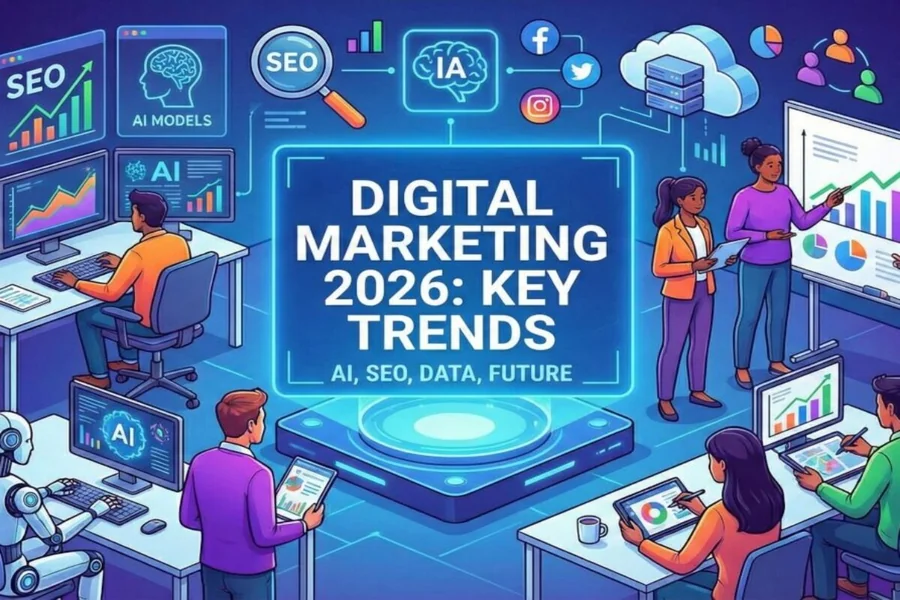
Social media marketing in 2026 looks very different from what it was just a few years ago. Platforms are more crowded, audiences are more selective, and algorithms are more advanced than ever. At the same time, opportunities for brands, creators, and businesses have expanded dramatically. Success now depends less on posting frequently and more on creating meaningful, data-driven, and human-centered content that fits how people actually use social platforms today.
The biggest shift in 2026 is that social media is no longer just a branding tool—it has become a full business engine that drives discovery, sales, customer service, and long-term loyalty. Businesses that understand this shift are pulling ahead, while those still treating social media as a “content feed” are falling behind.
The Rise of AI-Driven Marketing
Artificial intelligence is now deeply embedded in almost every aspect of social media marketing. From content creation to ad optimization, AI tools are helping marketers work faster and make more informed decisions. Industry trends show that AI is increasingly used to generate content ideas, analyze engagement patterns, and even produce visuals and short-form videos at scale.
However, the most successful brands in 2026 are not relying on AI alone. Instead, they use it as a support system. AI handles repetitive and analytical tasks, while humans focus on creativity, storytelling, and emotional connection. This balance between automation and authenticity is essential because audiences are quick to detect content that feels too generic or artificial.
AI is also transforming targeting and personalization. Social platforms now use advanced predictive systems to show users highly relevant content and ads. This means marketers must create more precise messaging tailored to niche audience segments rather than broad demographics.
Short-Form Video Still Dominates
Short-form video continues to be the most powerful content format in 2026. Platforms like TikTok, Instagram Reels, and YouTube Shorts remain central to user engagement strategies. Brands are prioritizing short-form video because it captures attention quickly and aligns with shrinking attention spans.
But what has changed is the level of competition. Simply posting short videos is no longer enough. The winning formula now includes strong hooks in the first few seconds, storytelling that feels authentic, and content that encourages interaction such as comments, shares, or replays.
User-generated content (UGC) also plays a major role in video marketing. Audiences trust real people more than polished advertisements, which is why brands increasingly incorporate customer-created content into their campaigns. Modern marketers often rely on an AI logo generator to produce professional brand assets for multiple social platforms.
The Shift From Reach to Relationships
One of the most important changes in social media marketing is the move away from chasing mass reach and toward building deeper audience relationships. Instead of focusing on going viral, brands are now prioritizing community-building and long-term engagement.
Smaller, niche communities are growing rapidly across platforms like Discord, Reddit, and private group spaces. These communities allow users to interact in more meaningful ways, away from the noise of public feeds. As a result, brands that invest in these spaces often see stronger loyalty and higher conversion rates.
This shift reflects a broader trend: audiences are experiencing social media fatigue. With so much content competing for attention, users prefer fewer but more relevant interactions. Successful marketers are responding by focusing on quality over quantity and creating content that feels personal rather than mass-produced.
Influencer Marketing Evolves
Influencer marketing in 2026 has matured significantly. Instead of prioritizing celebrities or macro-influencers with large follower counts, brands now focus on micro and nano influencers who have smaller but highly engaged audiences.
These creators often deliver better results because their communities trust them more and view their recommendations as authentic. Many brands now work with multiple smaller influencers rather than investing in a single large partnership. This creates more diverse reach and better conversion rates.
Many brands in competitive markets rely on a New York influencer marketing agency to manage creator partnerships and campaigns, especially when scaling across fast-moving industries where timing and audience targeting are critical.
Long-term collaborations are also replacing one-off sponsored posts. Instead of short campaigns, brands are building ongoing relationships with creators who consistently represent their products. This helps maintain authenticity and strengthens brand credibility.
Additionally, the rise of UGC creators—people who are paid specifically to produce content that looks organic—has blurred the line between advertising and real user experiences. This type of content is now widely used in paid advertising campaigns because it performs better than traditional polished ads.
Social Commerce Becomes Standard
Social media is no longer just about engagement—it is now a direct sales channel. Social commerce has become fully integrated into platforms, allowing users to discover, evaluate, and purchase products without leaving the app.
A growing trend in 2026 is conversational commerce, where users can interact with brands through chat systems and AI assistants that guide them through the buying process. This makes the customer journey smoother and more personalized.
The result is that marketing, sales, and customer service are no longer separate functions. Instead, they are merging into a single social-driven experience where every interaction can potentially lead to conversion.
Content Strategy Is Now Performance-Based
In 2026, social media content is judged less by creativity alone and more by performance metrics. Every post must serve a clear purpose—whether that is brand awareness, lead generation, engagement, or direct sales.
Marketers now carefully track how each piece of content contributes to business goals. This has led to more structured content planning and fewer random posts. Brands are also repurposing content across multiple platforms instead of creating separate content for each channel.
At the same time, algorithms continue to evolve. Engagement signals such as watch time, saves, shares, and comments carry more weight than likes. This forces marketers to prioritize meaningful interaction rather than superficial metrics.
The Importance of Authenticity
Despite all the technological advances, authenticity remains the most important factor in social media marketing. Audiences are increasingly skeptical of overly polished content and prefer real, relatable stories.
Brands that succeed in 2026 are those that communicate honestly, show behind-the-scenes processes, and engage directly with their communities. Even large companies are adopting a more casual, human tone in their messaging to build trust.
This focus on authenticity also extends to transparency in advertising. Users want to know when they are viewing sponsored content, and they respond better when brands are upfront about partnerships and promotions.
Conclusion
Social media marketing in 2026 is defined by a combination of technology, authenticity, and community. AI tools and automation have made marketing more efficient, but they have not replaced the need for human creativity and emotional connection. Short-form video, influencer ecosystems, and social commerce continue to dominate, while community-driven engagement becomes increasingly important.
Ultimately, success in this new era depends on understanding that social media is no longer just a marketing channel—it is a full ecosystem where discovery, communication, and commerce happen together. Brands that adapt to this integrated environment, embrace AI responsibly, and stay authentic in their communication will be the ones that thrive in the years ahead.