
1. A New Era of Traffic Safety in 2026
Traffic safety in 2026 is being reshaped by rapid advances in automation, artificial intelligence, and connected infrastructure. Traditional safety measures such as signage, speed enforcement, and driver education are still essential, but they are now part of a much larger ecosystem. Vehicles can sense their surroundings in real time, communicate with infrastructure, and even anticipate certain types of collisions before they happen. Governments and manufacturers are no longer focusing only on minimizing injury in crashes, but increasingly on preventing crashes altogether. This shift marks a major transition from reactive safety systems to predictive and data-driven safety networks that operate continuously across roads, vehicles, and cities. As a result, traffic safety is becoming less about isolated human decisions and more about coordinated system intelligence.
2. Advanced Driver Assistance Becomes Standard
One of the most significant changes in 2026 is the widespread adoption of advanced driver assistance systems (ADAS). Features such as automatic emergency braking, adaptive cruise control, lane centering, and driver attention monitoring are now common in mid-range vehicles, not just luxury models. These systems use cameras, radar, and increasingly AI-based prediction models to reduce human error, which remains the leading cause of road accidents. Rather than replacing drivers, ADAS acts as a continuous safety layer that intervenes in critical moments. However, this also introduces new challenges, particularly driver overreliance and misunderstanding of system limitations. Safety organizations like Euro NCAP have updated testing standards to evaluate not only crash performance but also how effectively vehicles support safe driving behavior in real-world conditions.
3. Partial Autonomy and Regulatory Catch-Up
Semi-autonomous driving is expanding rapidly in 2026, especially on highways and in controlled urban environments. Level 2 systems, which assist with steering and speed but still require driver supervision, are now widespread, while early Level 3 systems allow limited hands-off driving under specific conditions. This transition is forcing regulators to redefine responsibility on the road. If a system is driving but a human must still supervise, determining liability in an accident becomes complex. Governments are responding with new legal frameworks that define when control is considered transferred from driver to system. These frameworks also require manufacturers to provide clearer operational boundaries, ensuring drivers understand exactly when automation is safe to use and when it is not.
4. Smart Infrastructure and Connected Roads
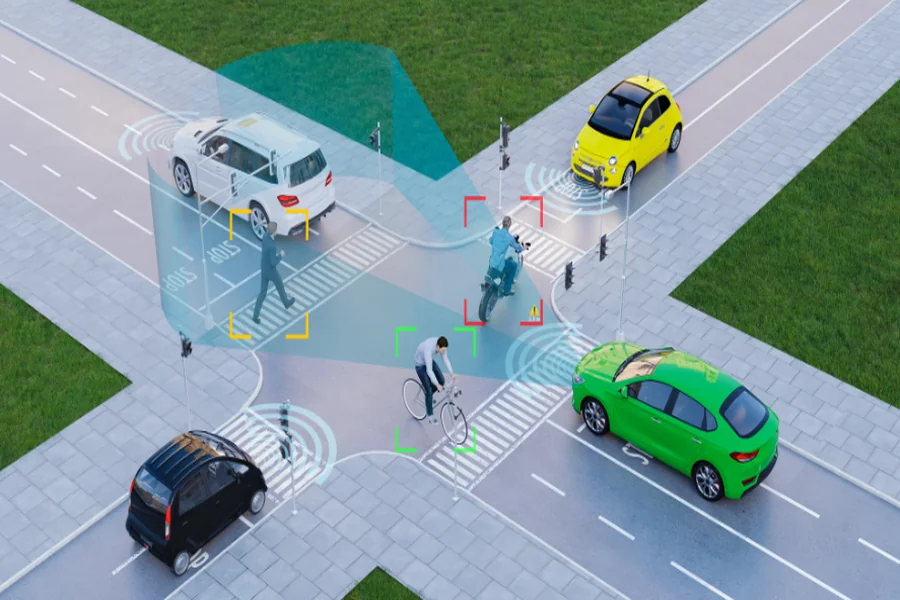
Traffic infrastructure is also evolving into a digital network. In 2026, many cities are deploying vehicle-to-everything (V2X) systems that allow cars to communicate with traffic lights, road sensors, and other vehicles. This connectivity helps reduce intersection collisions, improves emergency vehicle routing, and enables dynamic traffic signal adjustments based on congestion levels. Roads are no longer static systems but responsive environments that adapt in real time to traffic flow and weather conditions. In some regions, speed limits can automatically adjust during heavy rain or high congestion, improving both safety and efficiency. This integration between infrastructure and vehicles is gradually turning urban traffic into a coordinated, self-regulating system.
5. AI Enforcement and Modern Traffic Management
Traffic enforcement in 2026 is increasingly powered by artificial intelligence. Automated camera networks now detect speeding, illegal lane changes, distracted driving, and red-light violations with higher accuracy than traditional systems. These tools reduce the need for constant human monitoring while increasing enforcement coverage across large urban areas. In addition, some municipalities are experimenting with predictive safety systems that identify high-risk zones before accidents occur and adjust enforcement or signaling accordingly. A growing number of cities are also outsourcing parts of traffic monitoring to specialized service providers, including a traffic control company that manages digital surveillance systems, coordinates real-time signal adjustments, and analyzes traffic flow data to improve road safety outcomes. This blend of public oversight and private technical support is reshaping how enforcement is delivered.
6. Electric Vehicles and Safety-First Design
Electric vehicles (EVs) are playing a major role in transforming traffic safety design. Because EV platforms are built around software and centralized computing systems, they integrate more easily with advanced sensors and automated driving features. The low center of gravity in EVs also improves stability and reduces rollover risk in crashes. Additionally, EVs often include pedestrian warning systems that emit external sounds at low speeds to improve awareness in urban environments. Manufacturers are increasingly designing vehicles where safety features are not add-ons but core architectural components. This shift allows faster deployment of over-the-air updates that can improve braking systems, sensor accuracy, and driver assistance algorithms without requiring physical recalls.
7. Human Behavior and the Future of Road Safety
Despite technological progress, human behavior remains the most unpredictable factor in traffic safety. Distracted driving, fatigue, speeding, and misuse of automation systems continue to cause a large portion of accidents worldwide. One of the emerging challenges in 2026 is ensuring that drivers understand the limits of assistance technologies. Overconfidence in automated systems can lead to delayed reactions in critical situations. As a result, education campaigns are shifting toward teaching “automation literacy,” helping drivers understand when to trust the system and when to take control. Looking ahead, the future of traffic safety will likely depend on a balanced partnership between humans and machines, where technology reduces risk but human awareness remains an essential layer of protection.